
Schema markup: boost your SEO visibility and prepare for AI
20 October 2024
WordPress SEO: The complete guide to boosting your site to the top of Google
31 December 2024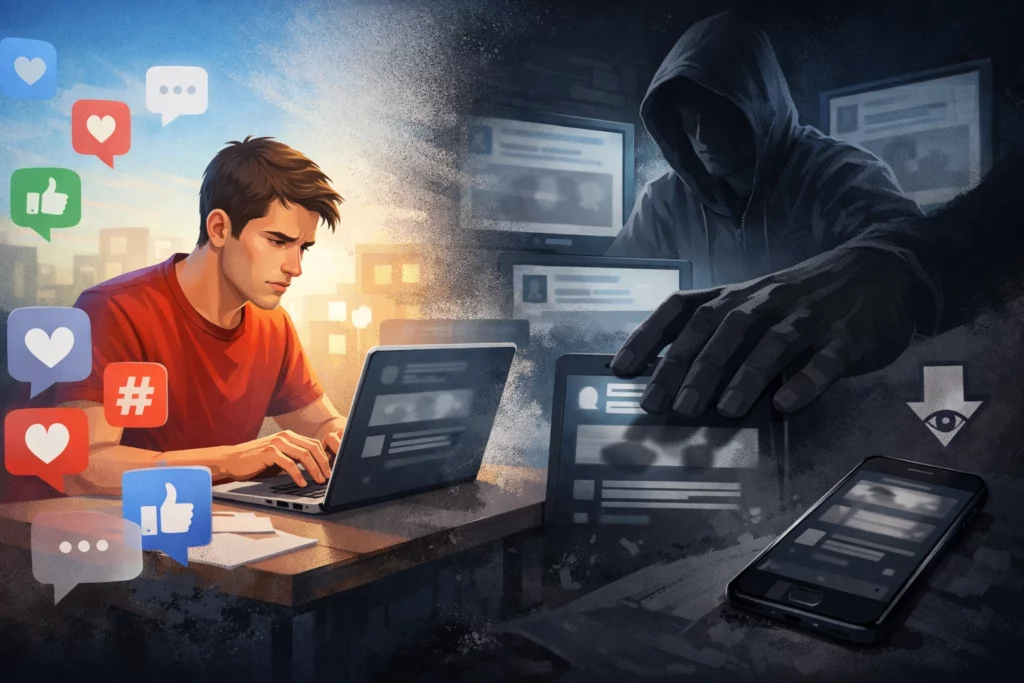
You publish regularly on your social networks, but over the past few weeks, your statistics have plummeted. Your posts are no longer appearing in news feeds, your hashtags aren’t generating any visibility, and your engagement has inexplicably plummeted. Welcome to the opaque world of shadow banning, the invisible penalty that can ruin your online presence without you ever understanding why.
Shadow banning is one of today’s most insidious threats to brands and content creators. Unlike a classic ban, you are never notified. Your account remains active, you can publish normally, but no one sees your content anymore. It’s like talking to an empty room and believing you have an audience.
Key points to remember
- Shadow banning is a reduction in visibility applied by platforms without notifying the user.
- Instagram, TikTok, X (formerly Twitter) and Facebook use this practice to moderate content
- A sudden drop in commitment of 50% or more may signal shadow banning
- Automated behavior, excessive use of hashtags and inappropriate content are the main causes.
- The Digital Services Act (DSA) now requires greater transparency from platforms since 2023
- An authentic content strategy that respects community rules remains the best protection.
What exactly is shadow banning?
Shadow banning is a moderation technique that drastically limits the reach of your publications without informing you directly. Your existing subscribers can still see your content, but you disappear completely from searches, discovery pages and non-subscribers’ news feeds.
This practice has become widespread on the major social platforms in recent years. Instagram, TikTok, X and Facebook use it as an automated regulatory tool, managed by increasingly sophisticated algorithms. The stated aim? To combat spam, inappropriate content and abusive behavior that degrades the user experience.

The problem is that this silent censorship doesn’t always distinguish the real offenders from the legitimate users. A brand may find itself penalized for simply using a popular hashtag that has recently been associated with problematic content. It’s this gray area that makes shadow banning so frustrating.
Why do platforms use shadow banning?
Social networks face a colossal challenge: moderating billions of daily publications while maintaining a quality user experience. Shadow banning represents their solution for automating this moderation without generating direct conflicts with users.
The main reasons include:
Fighting spam and automation: Bots and automated accounts pollute platforms with repetitive content. By silently reducing their reach, algorithms limit their impact without triggering a wave of new accounts.
Moderating sensitive content: Disinformation, hate speech, violent or sexually explicit content – platforms try to limit the spread of this type of content without necessarily deleting it immediately.
Protecting the user experience: Behaviors considered aggressive (excessive tagging, unsolicited messages, over-publication) are sanctioned to avoid saturating users.
Regulatory compliance: with the Digital Services Act coming into force in Europe from August 2023, platforms must demonstrate that they are actively moderating problematic content. Shadow banning enables them to display impressive moderation statistics.
How do you know if you are a victim of shadow banning?
Detecting shadow banning isn’t easy, precisely because it’s designed to be invisible. However, there are several warning signs that can point you in the right direction.
A sudden drop in engagement: If your engagement rate drops by 50% or more overnight, for no apparent reason, this is the first indicator. Compare your statistics over several weeks to identify an abnormal trend.
Disappearing discovery pages: Ask someone who doesn’t follow you to search for your profile in private browsing mode. If your account doesn’t appear in the results or is hard to find, it’s a red flag.
Your hashtags no longer work: Post with a specific hashtag and check whether your post appears in the recent results for that hashtag. If you’re invisible, it’s a clear sign of limited reach.
No interaction from new users: If only your existing subscribers interact with your content, and you’re not attracting any new followers despite quality content, you’re probably a victim of shadow banning.

Some online tools promise to detect shadow banning, but their reliability remains limited. Methodical observation of your native statistics remains the safest method.
How to remedy the situation and protect your online presence
If you suspect shadow banning, don’t panic. Solutions exist to restore your visibility, but they require patience and a methodical approach.
Immediate action to be taken
Take a strategic break: drastically reduce your posting frequency for 48 to 72 hours. This pause allows the algorithm to “reset” your profile.
Remove problematic content: Review your most recent posts and identify those that may have triggered the sanction. Sensitive content, banned hashtags, inappropriate language – remove anything that could cause a problem.
Check your security settings: Change your password, check the third-party applications connected to your account and revoke access to any suspicious automation tools.
Long-term preventive strategies
Scrupulously respect community rules: Each platform publishes detailed guidelines. Take the time to read and understand them. What’s acceptable on TikTok isn’t necessarily acceptable on Instagram.
Vary your hashtags intelligently: Never use the same hashtags repeatedly. Create pools of relevant hashtags and alternate them. Avoid hashtags that are banned or associated with problematic content.
Prioritize authenticity over automation: Bots and automation tools are detectable. Prefer manual engagement, even if it takes longer. Authenticity always pays off in the long run.
Diversify your content formats: Don’t just publish photos or videos. Algorithms favor diversity. Alternate between Reels, Stories, classic posts and carousels on Instagram, for example.
Pay attention to your engagement/publication ratio: If you publish 10 times a day but generate no interaction, the algorithms will identify you as a spammer. It’s better to publish less but better.
DS Overseas expertise for a secure social presence
Managing a presence on social networks is no longer limited to publishing attractive content. You now have to navigate a complex algorithmic environment where one strategic mistake can cost you months of work.
At DS Overseas, we help brands build a robust and sustainable social strategy. Our approach combines technical expertise and creativity to maximize your reach while scrupulously respecting the rules of each platform.
We implement monitoring protocols that detect anomalies before they become problematic. Our teams regularly audit your accounts to identify potential risks and adjust your strategy accordingly.
Shadow banning is not an inevitability, but a constraint that needs to be anticipated and managed professionally. With the right strategy and the right partners, your online presence can thrive in full compliance with algorithmic rules.
Conclusion: Transparency as the new standard
The entry into force of the Digital Services Act marks an important turning point. Platforms are now obliged to be more transparent about their moderation practices. Users have more recourse to challenge algorithmic decisions that affect them.
This regulatory evolution should gradually make shadow banning more transparent and fairer. In the meantime, the best defense remains a content strategy that is irreproachable, authentic and respectful of the communities you serve.